The Cognitive Cost of Substituting Technology for Literacy Instruction
Posted by Brainspring on 2nd Jun 2026



The Cognitive Cost of Substituting Technology for Literacy Instruction
In The Digital Delusion, cognitive neuroscientist Jared Cooney Horvath (2026) issues a research-driven challenge to the widespread assumption that more classroom technology produces better learning. Drawing on decades of cognitive science, Horvath argues that schools have systematically mistaken access to digital tools for access to learning, and that the unexamined integration of devices into core instruction has eroded the very practices most strongly associated with durable knowledge: handwriting, sustained reading, multisensory engagement, and embodied practice. His argument is not anti-technology but anti-substitution. When digital tools replace, rather than supplement, the effortful cognitive work that produces learning, they undermine the foundational practices that build skilled readers and writers.
The literacy classroom is where this tension is most consequential. Reading and writing are biologically secondary processes; unlike spoken language, they do not develop naturally through exposure but must be explicitly, systematically taught through instruction that recruits multiple sensory and motor systems (Moats, 2020). Structured Literacy, the evidence-based instructional framework grounded in the Science of Reading, recognizes this developmental reality by emphasizing explicit, multisensory techniques that strengthen sound-symbol connections and support orthographic mapping (Spear-Swerling, 2024). When technology substitutes for these practices rather than reinforcing them, instruction risks bypassing the very neural mechanisms reading depends upon.
The Cognitive Cost of Substitution
These concerns align closely with research on the effects of analog and digital learning experiences. Ibaibarriaga et al. (2026) demonstrated that children who practiced letter and word learning by hand outperformed peers who practiced by typing, with measurable advantages persisting across literacy tasks. Wolf and Berninger (2018) similarly found that multi-modal handwriting instruction, including cursive, reduces letter reversals, reinforces sound-symbol relationships, and supports the integration of motor planning and visual processing systems essential to written expression. These findings carry weight for students with dyslexia, for whom cursive instruction has been shown to support spelling, composition, and the development of efficient neural pathways for reading (Fujita, 2024; Wolf & Berninger, 2018).
The effects of digital devices on reading go beyond just handwriting. According to Wolf, who was interviewed on Brainspring's Orton Gillingham Podcast (2025), students who read on digital devices tend to skim the surface of the text rather than accomplish the deep processing that leads to comprehension. Other researchers, such as McIver, Gee, and Gitlow (2023), have found that when assistive technology is used exclusively, without explicit instruction, it can actually hinder learning, particularly in multisensory encoding that promotes orthographic mapping, which allows unfamiliar words to be stored and recognized automatically in long-term memory. For example, text-to-speech tools can make it easier for students to access grade-level content, but they do not help build the neural pathways that are necessary for real understanding. Both of these functions are important, but they serve different purposes and cannot be used interchangeably. In other words, technology can be a useful tool, but it should not replace explicit instruction and hands-on learning. By combining these approaches, we can help students develop a deeper understanding of the material and improve their reading skills.
Technology can be a useful tool, but it should not replace explicit instruction and hands-on learning.
Multisensory, Hands-On Practice as Cognitive Infrastructure
Brainspring's Language to Literacy™ framework treats multisensory and multimodal instruction not as a teaching style preference but as a core instructional principle aligned with how the brain learns. Effective instruction for students with dyslexia and other learning differences must be explicit, systematic, cumulative, and diagnostic, with multisensory techniques used to strengthen sound-symbol connections and support orthographic mapping (Moats, 2020; Odegard, 2024). Research on morphological instruction further reinforces this point: Eggleston et al. (2024) used functional near-infrared spectroscopy to demonstrate that morphological awareness tasks activate both sound and meaning networks in the brain, with measurable improvements in single-word and connected-text reading.
These findings are not just important for students receiving intervention services. Research on Universal Design for Learning (UDL) shows that hands-on learning benefits all students, alongside other forms of instruction like audio, video, and text (Almeqdad et al., 2023). Research on differentiated instruction also emphasizes the importance of multisensory learning, as students enter the classroom with a wide range of learning experiences, strengths, and needs, including differences in language, attention, movement, and sensory processing (Tare et al., 2022). Spelling instruction is one clear example of why multisensory instruction matters. When students write and practice words by hand using multisensory techniques, such as Brainspring's Phonics First ® Dictation practice, they strengthen both the reading and spelling systems in the brain at the same time. This connection between decoding and encoding helps build stronger overall reading skills (Truckenmiller & Chandler, 2023).
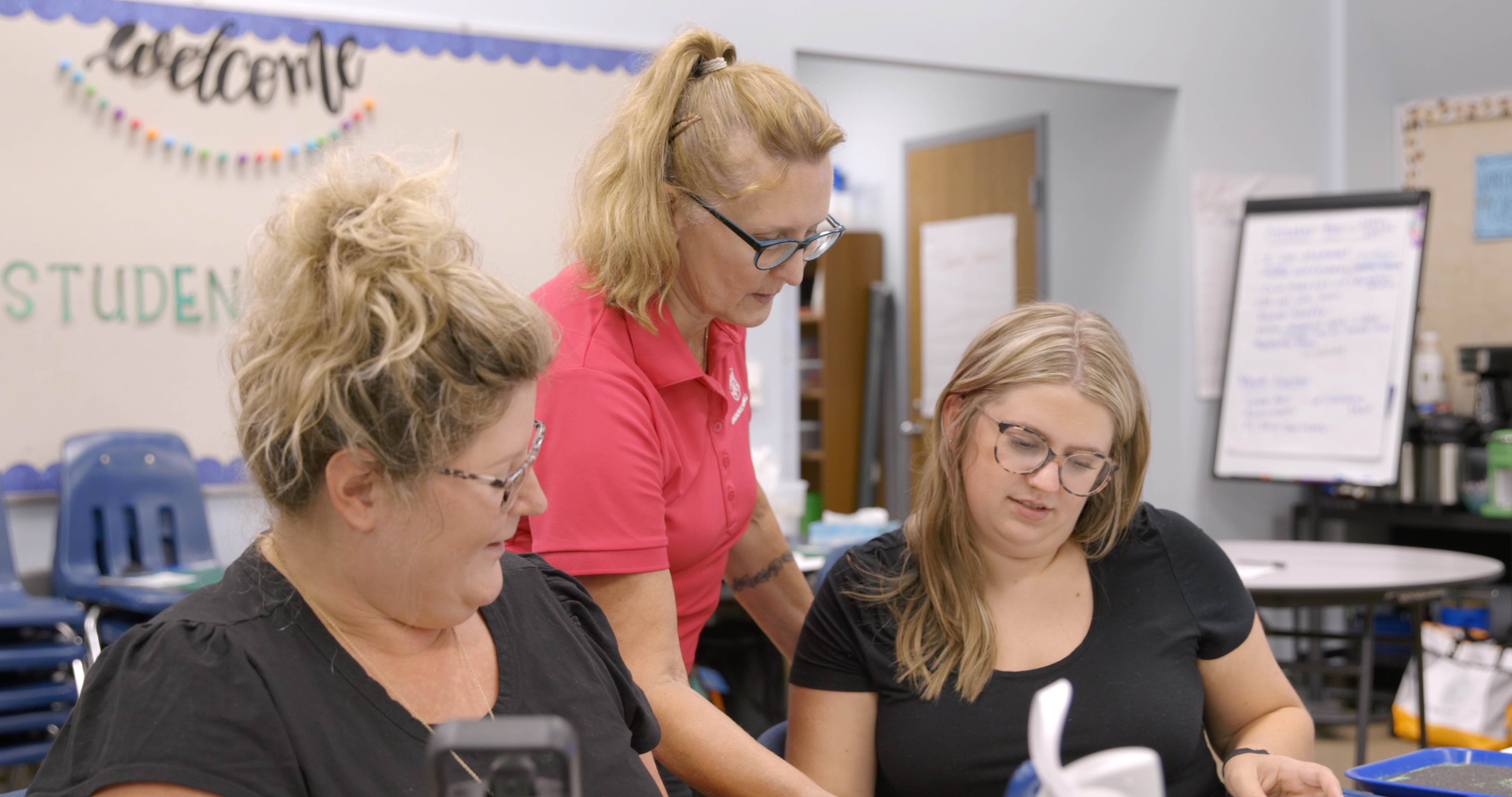
Technology as Enhancement, Not Replacement
The key to using technology in the classroom is ensuring that it supports student learning rather than completing the work for them. This idea is supported by researchers like Horvath, who say that technology should enhance teaching, not replace it. The best uses of technology and artificial intelligence in the classroom are those that support students' thinking without doing the thinking for them (Gierka & Odegard, 2025; Wexler, 2025). The International Dyslexia Association emphasizes that AI tools should still require students to engage in the mental effort needed for learning, fluency, and long-term memory. Technology should support explicit instruction, not replace it (Gierka & Odegard, 2025). For example, when students use AI to avoid challenging work, they also miss the practice that helps the brain learn and grow. But when students first think independently and then use AI to extend or clarify their understanding, the technology can become a helpful learning support rather than a shortcut.
This distinction is best operationalized through intentional instructional design. A student may use speech-to-text in the general education classroom to support written expression while simultaneously participating in structured handwriting and multisensory spelling instruction during intervention (McIver et al., 2023). Both supports are appropriate. The error lies not in technology itself but in allowing technology to substitute for the foundational practices it was meant to support.
Implications for the Literacy Classroom
Taken together, Horvath's (2026) argument and research from cognitive neuroscience, Structured Literacy, and special education point to an important conclusion: hands-on, multisensory learning should be at the center of literacy instruction, not treated as just one option among many. Technology and devices can play a valuable role in supporting access, accommodations, and differentiation, but they should not replace, but support, explicit teaching and active learning. Students learn to read and write by speaking, listening, moving, writing, and engaging multiple senses, not simply by looking at a screen. Technology can support literacy learning, but it cannot substitute for the cognitive and sensory experiences that build skilled reading and writing.
References
Almeqdad, Q. I., Alodat, A. M., Alquraan, M. F., Mohaidat, M. A., & Al-Makhzoomy, A. K. (2023). The effectiveness of universal design for learning: A systematic review of the literature and meta-analysis. Cogent Education, 10(1). https://doi.org/10.1080/2331186x.2023.2218191
Eggleston, R. L., Marks, R. A., Sun, X., Yu, C.-L., Zhang, K., Nickerson, N., Hu, X., Caruso, V., & Kovelman, I. (2024). Lexical morphology as a source of risk and resilience for learning to read with dyslexia: An fNIRS investigation. Journal of Speech, Language, and Hearing Research, 67, 2269-2282. https://doi.org/10.1044/2024_JSLHR-23-00293
Eggleston, R. L., Marks, R. A., Sun, X., Yu, C.-L., Zhang, K., Nickerson, N., Hu, X., Caruso, V., & Kovelman, I. (2024). Lexical morphology as a source of risk and resilience for learning to read with dyslexia: An fNIRS investigation. Journal of Speech, Language, and Hearing Research, 67, 2269-2282. https://doi.org/10.1044/2024_JSLHR-23-00293
Gierka, M. V., & Odegard, T. N. (2025). Using AI to support structured literacy: Aligning tools with how students learn. International Dyslexia Association.
The Digital Delusion by J. C. Horvath, published in 2026 by LME Global.
Ibaibarriaga, G., Acha, J., & Perea, M. (2026). Corrigendum to "The impact of handwriting and typing practice in children's letter and word learning: Implications for literacy development." Journal of Experimental Child Psychology, 262, 106376. https://doi.org/10.1016/j.jecp.2025.106376
McIver, J. L., Gee, B. M., & Gitlow, L. (2023). Assistive technology and specific learning disability: A case report. Assistive Technology, 37(1). https://doi.org/10.1080/10400435.2023.2262333
Odegard, T. (2024). Structured literacy: The backbone of a robust literacy ecosystem. Perspectives on Language and Literacy, 50(1). International Dyslexia Association.
Spear-Swerling, L. (2024). The "how" of structured literacy: Just as important as the "what." Perspectives on Language and Literacy, 50(1). International Dyslexia Association.
Tare, M., Shell, A. R., & Jackson, J. (2022). Shifting mindsets: Designing lessons for learner variability. Digital Promise.
Truckenmiller, A. J., & Chandler, B. W. (2023). Writing to read: Parallel and independent contributions of writing research to the science of reading. The Reading League Journal.
Wexler, N. (2025). Beyond the science of reading: Connecting literacy instruction to the science of learning. ASCD.
Wolf, M. (2025). Maryanne Wolf on digital literacy [Audio podcast episode]. In Brainspring Orton Gillingham Podcast. Brainspring.